

All Essential Vector Algebra Formulas PDF [100% Free]

Welcome to our comprehensive guide on vector algebra formulas! Whether you’re a student, educator, or just curious about vectors, this PDF compilation contains 100% free essential formulas to help you master vector concepts.
Physical Quantity: Property of a material or system that we can measure using numbers. These measurements have two important components:
- Magnitude: This represents the size or amount of the property.
- Unit: The unit gives meaning to the numerical value and allows us to compare and communicate data effectively.
There are mainly two type of physical quantity:
- Scalar Quantity: completely defined by only Magnitude.
- Vector Quantity: defined by Magnitude and Direction.
Vectors Representation/Notation
Vector Quantity has both Magnitude and Direction and must be follow vector algebra.

where A = magnitude of  and
and  = direction (unit vector)
Comparison between Scalar and Vector Quantity
| Scalar Quantity | Vector Quantity |
|---|---|
| Defined by only Magnitude | Magnitude + Direction |
| Follow Normal Algebraic Rules | Follow Vector Algebraic Rules |
| Scalar quantities are added, subtracted, or divided by Algebraically | Vector quantities are added and subtracted Geometrically |
| Examples: Length, Distance, Speed, Mass, Volume, Time, Time, Temperature, Work, Energy, Power, Electric Current, Charge, Potential, Flux, etc. | Examples: Position, Displacement, Velocity, Weight, Acceleration, Electric Field, Surface Area, Force, Torque, etc. |
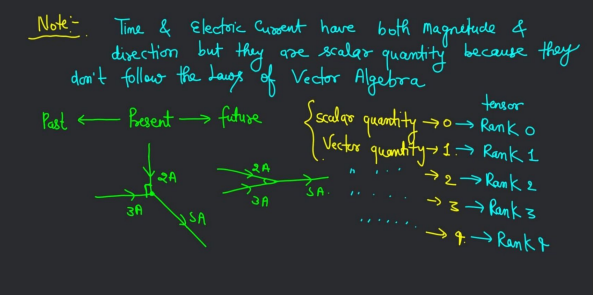
Physical Quantities having different values in different direction known as Tensor.
Examples: Moment of inertia, Refractive Index, Density Stress and Stain, etc.
Key Point:
Types of Vectors
| Sr.No. | Vector Type | Definition |
|---|---|---|
| 1. | Equal Vectors | Magnitudes  & Direction & Direction  |
| 2. | Opposite Vectors | Two vectors &  are said to be opposite vectors if thier magnitudes are same but direction is opposite. are said to be opposite vectors if thier magnitudes are same but direction is opposite. |
| 3. | Position Vector |  |
| 4. | Displacement Vector |  |
| 5. | Unit Vector |  Magnitude: Unit (1), Direction: |
| 6. | Orthogonal Unit Vectors | The unit vector along x-axis  , y-axis , y-axis & z-axis & z-axis  called orthogonal vectors. and called orthogonal vectors. and  |
| 7. | Zero / Null Vector ( ) ) | Magnitude: Zero (0) Direction: Arbitrary |
| 8. | Collinear Vectors | Two Parallel or Antiparallel vectors are called colinear vectors.  |
| 9. | Coplanar Vectors | Vectors having same Plane or Parallel Plane are called coplanar. If , and  are coplanar then, are coplanar then, ![V=\vec{A}.[\vec{B}\times\vec{C}]=0](https://physicsscholar.com/wp-content/ql-cache/quicklatex.com-f33069e45b324c68e3e6be16f1ea1d30_l3.png "Rendered by QuickLaTeX.com") |
| 10. | Polar Vector | These vectors have defined initial point. Examples: displacement, force, position, velocity, linear momentum..etc. |
| 11. | Axial Vector | These vectors always along an axis. Examples: angular momentum, angular velocity, torque, etc. |
Addition of Vectors
- Triangle Law of vector Addition: If two vectors A and B are represented as two sides of a triangle taken in order, then the third side of the triangle represents the resultant vector R:

- Parallelogram law of vector addition: If two vectors A and B represented as adjacent sides of a parallelogram, then the diagonal of the parallelogram represents the resultant vector R:
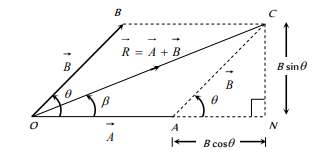
Magnitude of the Resultant Vector: 
Direction of Resultant Vector: 
Case (1): If & are parallel i.e.  then, then, (maximum resultant) (maximum resultant) |
Case (2): If & are Perpendicular i.e.  then, then, |
Case (3): If & are Anti-parallel i.e.  then, then,  (minimum resultant) (minimum resultant) |
Subtraction of vectors
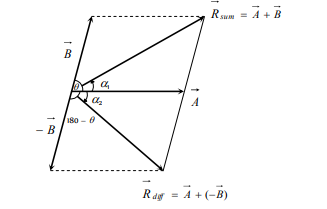
Magnitude of the Resultant Vector: 
Direction of Resultant Vector: 
Case (1): If & are parallel i.e. then,  (minimum resultant) (minimum resultant) |
| Case (2): If & are Perpendicular i.e. then, |
Case (3): If & are Anti-parallel i.e. then, (maximum resultant) (maximum resultant) |
Formulas of Scalar Product of Two Vectors
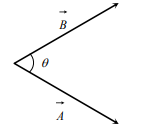
If and having angle  , then their scalar product is defined as:

![\theta=cos^{-1}[\frac{\vec{A}.\vec{B}}{AB}]](https://physicsscholar.com/wp-content/ql-cache/quicklatex.com-d16ff46ababa73066fcb37315836e48a_l3.png "Rendered by QuickLaTeX.com")
In terms of components, if  and
and 
![\vec{A}.\vec{B}=A_x\hat{i}+A_y\hat{j}+A_z\hat{k}.\vec{B}=B_x\hat{i}+B_y\hat{j}+B_z\hat{k}=[A_xB_x+A_yB_y+A_zB_z]](https://physicsscholar.com/wp-content/ql-cache/quicklatex.com-3cd5ebac84abbc309e756845d0401eac_l3.png "Rendered by QuickLaTeX.com")
Case (1): If & are parallel i.e. then, |
Case (2): If & are Perpendicular (orthogonal) i.e. then, 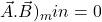 |
Scalar Product Properties
- It is always a scalar.
- If
 (acute) then dot product always be positive.
 - If
 (obtuse) then dot product always be negative.
  i.e. it is commutative.
 i.e. it is distributive.
- The scalar product of a vector by itself is termed as self dot product and is given by,
 i.e.
i.e. 
- The dot product of same orthogonal unit vectors :

- The dot product of orthogonal unit vectors :

Examples of Scalar Product
- Work :

- Energy :
 &
& 
- Power :

- Magnetic Flux :

Formulas of Vector Product of Two Vectors

![\theta=cos^{-1}[\frac{\vec{A}\times\vec{B}}{AB}]](https://physicsscholar.com/wp-content/ql-cache/quicklatex.com-06bed1a094666e5e974caeb6b55eefeb_l3.png "Rendered by QuickLaTeX.com")
In terms of components: if and
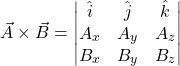

Case (1): If & are parallel i.e. or antiparallel i.e.  then, then,![[\vec{A}\times\vec{B}]_min= A0°](https://physicsscholar.com/wp-content/ql-cache/quicklatex.com-ca8bd2af7f354789c9869c2f18020e0c_l3.png "Rendered by QuickLaTeX.com") |
Case (2): If & are Perpendicular (orthogonal) i.e. then,  |
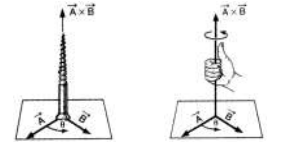
Vector Product Properties
- It is always a vector.
 i.e. Vector product of two vectors is not commutative.
 i.e. The vector product is distributive when the order of the vectors is strictly maintained.
- The self cross product, i.e., product of a vector by itself vanishes, i.e., is null vector

- The dot product of same orthogonal unit vectors :

- The dot product of orthogonal unit vectors :

Examples of Cross products


Comparison between Scalar and Vector products
| Properties | Scalar Product | Vector Product |
|---|---|---|
| Formula | | |
| Commutative | ⇒ ✅ | ⇒ ❌ |
| Distributive | | |
Vector Algebra Formulas PDF [100% Free]
